
Christ the Redeemer Facts, History, and Height
You stand on the narrow stone deck atop Mount Corcovado, looking up through swirling grey fog, and for several minutes there is nothing to see except white vapor and tourists adjusting their camera lenses. Then the Atlantic wind cuts hard across the peak. The cloud tears open in a split second, and the massive concrete face suddenly towers directly above you, silent and pale against the sky. Digging into the actual rio christ the redeemer facts reveals that this towering figure is far more than just a quick selfie stop; it is an improbable structural gamble completed in 1931 that still dominates every conversation about Brazilian identity.
Most travelers know the silhouette before they ever set foot in South America. What catches people off guard is the sheer engineering madness behind it. Perched 710 meters above the beaches of Copacabana and Ipanema, the statue looks like it simply grew out of the granite cliff. The real story involves thousands of handwritten notes glued under stone tiles, decades of Catholic fundraising campaigns, French sculpting ateliers, and a mountain railway built long before modern cranes existed. Whether you want to understand the history of Christ the Redeemer statue in Rio de Janeiro or verify how tall it stands against other global giants, here is the full breakdown of how this wonder came to be.
Book your rio christ the redeemer tour experience:
The Origins and Christ the Redeemer Rio History
The concept of placing a Christian cross or religious symbol on Corcovado was not born in the twentieth century. Back in the mid-1850s, a Vincentian Catholic priest named Pedro Maria Boss arrived in the city and spent hours staring up at the sheer granite dome from the botanical gardens below. He petitioned Princess Isabel, the regent of Brazil, for money to erect a grand religious monument on the mountain crest. She politely listened, but the imperial treasury had other priorities, and the project sat completely dead in the water. When Brazil abolished the monarchy and established a secular republic in 1889, the formal separation of church and state seemed to kill the proposal forever.
Everything changed after World War I. By the early 1920s, the Catholic Archdiocese of Rio de Janeiro was increasingly panicked by what its leadership perceived as a rapid slide toward godlessness, urban secularism, and Protestant inroads. To reassert the faith in public life, the church organized a massive national signature campaign and fundraiser known as the Semana do Monumento (Monument Week). Brazilian Catholics across the country chipped in small bills, copper coins, and household donations. Rich society women gave heirloom jewelry. Within a few short years, the church had raised over 250,000 US dollars entirely from private citizens, without asking for a cent of state funding.
The original visual proposal was shockingly different from what stands there today. Engineer Heitor da Silva Costa, who won the public design contest in 1921, initially sketched a figure of Christ clutching an enormous heavy wooden cross in his right hand while holding a celestial globe in his left. Locals jokingly nicknamed it "Christ with a Balloon." Thankfully, Da Silva Costa went back to the drawing board alongside Brazilian painter Carlos Oswald. Together, they realized that the silhouette needed to be clean, powerful, and instantly recognizable from five miles away. The outstretched arms forming a cross was chosen instead, greeting the ocean and embracing the entire bay.
Pro tip: If you want to beat the thick sea clouds that constantly blind Corcovado, monitor the city's coastal webcams at 7:00 AM before heading up; clear mornings often turn completely overcast by lunchtime.
Who Built Christ the Redeemer in Rio and the Construction Feat
Answering who built Christ the Redeemer in Rio requires untangling an international partnership across two continents. While Heitor da Silva Costa managed the overall project and structural logistics from Rio, he quickly admitted that he was not an artist. He traveled directly to Paris in 1923 to seek out Paul Landowski, a renowned French-Polish sculptor who worked in the bold, clean lines of the Art Deco style. Landowski spent months in his suburban Paris studio crafting the head and hands from clay, scaling them up piece by piece into full-size plaster casts. Romanian sculptor Gheorghe Leonida was brought in specifically to carve the delicate facial features, giving the head its calm, symmetrical expression.
Back in France, master structural engineer Albert Caquot was tasked with calculating how to build an empty, hollow concrete skeleton that would not buckle in hundred-mile-per-hour winds. Steel had been ruled out because salt air from the Atlantic Ocean would rust the frame from the inside out within three decades. Caquot convinced Da Silva Costa to use reinforced concrete, a relatively new construction material at the time. The plaster casts of the head and hands were carefully packed into wooden crates, loaded onto cargo ships across the ocean, and then hauled up Corcovado's narrow cogwheel railway track piece by piece.
The construction of Christ the Redeemer in Rio de Janeiro Brazil took nine full years, running from 1922 until its official dedication on October 12, 1931. Because the mountain summit drops off into vertical granite abysses on three sides, there was virtually no flat ground for scaffolding or staging materials. Workers mixed concrete on site with water pulled up the mountain via rail, balanced on flimsy wooden planks hundreds of meters above the jungle, and miraculously completed the entire build without a single fatal accident. For an industrial project in the 1920s, that safety record remains astonishing.
Once the concrete shell was poured, Da Silva Costa faced an aesthetic crisis: concrete looked drab, stained quickly in tropical downpours, and cracked under blistering sun. His solution came from Paris, where he noticed an ornamental fountain tiled in pale soapstone mosaic. Soapstone (steatite) from the quarries of Minas Gerais was soft enough to cut with a kitchen knife yet completely impermeable to rain and temperature swings. Millions of small triangular tiles were cut by hand. Society women across Rio gathered at churches to glue the soapstone chips onto strips of mesh fabric. Many of these women wrote personal prayers, family names, and secret wishes on the backs of the tiles before they were pasted onto the concrete skin, meaning the entire statue is literally wrapped in the private hopes of 1920s Cariocas.
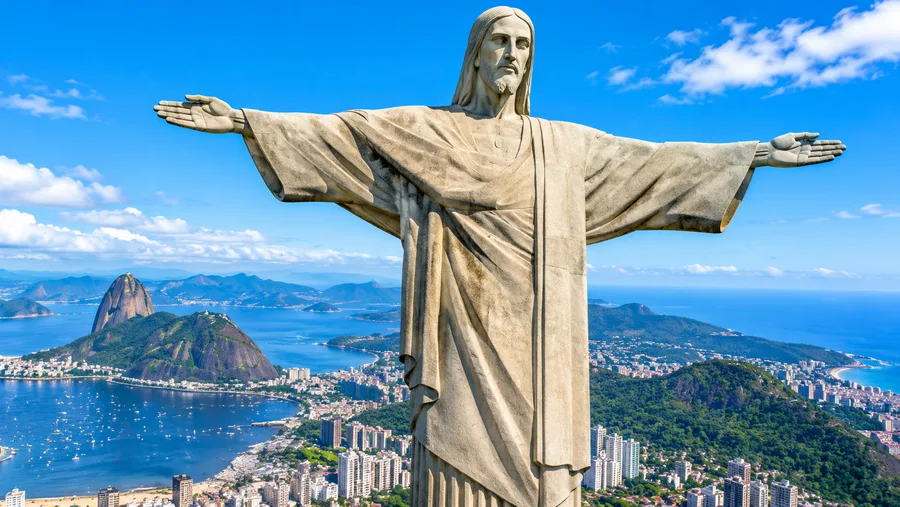
How Tall is Christ the Redeemer in Rio? Measurements and Dimensions
Visitors frequently ask how tall is Christ the Redeemer in Rio de Janeiro, often because photographs make it look either overwhelmingly gigantic or strangely modest against the vast green peaks. To be precise, the Rio de Janeiro Christ the Redeemer height measures exactly 30 meters (98 feet) from the soles of the sandals to the crown of the head. It sits on top of an 8-meter (26-foot) concrete pedestal that houses a small, functioning Catholic chapel dedicated to Our Lady of Aparecida, bringing the total combined height to 38 meters (124 feet).
To grasp the scale without looking at pure blueprints, consider these physical parameters:
- Total weight: roughly 1,145 metric tons of reinforced concrete and soapstone.
- Arm span: 28 meters (92 feet) from fingertip to fingertip across the chest.
- Head height: 3.75 meters (12.3 feet), weighing approximately 30 tons on its own.
- Individual hand length: 3.2 meters (10.5 feet), with each hand weighing over 8 tons.
- Soapstone skin: over 6 million individual triangular mosaic tiles covering the exterior.
When you stand directly below the plinth, the perspective distorts. The head is tilted slightly forward and down by a few degrees so that observers on the ground do not just see the underside of a chin, but feel as though the eyes are watching the city below. That slight downward tilt was a conscious decision by Landowski. It keeps the proportions looking human despite the massive scale.
If you plan to visit the summit yourself, read through our detailed breakdown on Christ the Redeemer Tickets and Visitor Guide to avoid the ticket scalpers and pick the right viewing window. The platform gets impossibly packed between 10:30 AM and 3:00 PM, leaving you very little room to back up far enough to capture both the pedestal and the crown in a single vertical frame.
Book your rio christ the redeemer tour experience:
Christ the Redeemer Lisbon vs Rio: The Two Colossal Statues
Travelers who have spent time in Portugal often experience a strange sense of déjà vu. Standing on the southern bank of the Tagus River in Almada, looking back toward Lisbon, is a towering Christ figure with identical outstretched arms. The comparison of Christ the Redeemer Lisbon vs Rio is common, but they are very different structures built decades apart with distinct motivations.
Lisbon's statue, properly named Santuário de Cristo Rei, was directly inspired by Rio's monument. The Cardinal Patriarch of Lisbon visited Rio de Janeiro in 1934, just three years after Corcovado was completed, and fell in love with the visual impact of the statue. He lobbied the Portuguese church to build their own version as a plea to God to spare Portugal from the horrors of World War II. Portugal remained neutral during the conflict, and construction on the Lisbon monument finally began in 1949 as an expression of national gratitude, opening to the public in 1959.
While Lisbon's Christ figure itself is slightly shorter than Rio's, its base is vastly taller. The Portuguese monument perches on a hollow, four-legged concrete portico that rises 82 meters into the air, making the total structure significantly higher off the pavement than Corcovado's statue. Corcovado, on the other hand, relies on 700 meters of sheer mountain elevation for its dramatic punch.
| Feature | Christ the Redeemer (Rio de Janeiro) | Cristo Rei (Lisbon / Almada) |
|---|---|---|
| Year Dedicated | 1931 | 1959 |
| Statue Height (figure only) | 30 meters (98 ft) | 28 meters (92 ft) |
| Pedestal Height | 8 meters (26 ft) | 82 meters (269 ft) |
| Total Structure Height | 38 meters (124 ft) | 110 meters (361 ft) |
| Base Elevation (Above Sea Level) | 710 meters (2,329 ft) | 133 meters (436 ft) |
| Primary Material | Reinforced concrete & soapstone | Reinforced poured concrete |
Which one is more impressive depends on what you value. Lisbon gives you an elevator ride inside the cavernous pedestal up to a viewing platform with panoramic vistas of the 25 de Abril suspension bridge. Rio's statue of Christ the Redeemer in Rio de Janeiro, however, is woven straight into the raw topography of the Tijuca National Park jungle, making it feel organic to the mountain landscape rather than an engineered concrete tower.
Note: Corcovado's summit platform is exposed to severe weather without shelter; if a sudden lightning squall sweeps across Guanabara Bay, park rangers will immediately evacuate visitors down the escalators for safety.

Little-Known Christ the Redeemer Statue Rio Facts
Behind the postcard imagery sits a collection of strange technical quirks and historical anecdotes that most guided tours completely skip over. Here are several unusual details about Rio's Christ the Redeemer statue:
- It functions as an enormous lightning rod: Mount Corcovado takes between 3 to 6 direct lightning hits every single year. A network of grounding cables runs through the arms and head, dispersing the electrical charge down through the concrete core and into the mountain rock.
- Finger tips get blasted off: During a violent electrical storm in January 2014, a lightning strike fractured the right thumb and chipped two fingertips, requiring specialist rope-access steeplejack masons to dangle off the arms for weeks carrying fresh soapstone replacement mortar.
- The soapstone color is changing: The original quarry in Minas Gerais that supplied the pale greenish stone has run dry. Modern restoration teams have to source replacement stone from alternative seams, which are noticeably darker, slowly giving the statue a subtle patchwork pattern up close.
- There is a hollow heart inside: While the exterior looks solid, the statue is entirely hollow inside, accessible via narrow metal ladders and trapdoors. Inside the chest wall, the engineers formed a small, stylized relief heart measuring about 1.3 meters across, echoing the Sacred Heart devotion.
- It was almost green: Some city planners in the 1920s lobbied to paint the statue deep forest green so it would blend in with the Atlantic forest canopy. Thankfully, cooler heads insisted that contrast was the entire point of a navigational landmark.
Reaching the peak can be accomplished by the historic electric railway, licensed tourist vans, or an exhausting three-hour trek through the rain forest. If you decide to tackle the trail, check our guide on How to Get to Christ the Redeemer in Rio for practical notes on safety and hydration along the Parque Lage route.
The monument was officially chosen as one of the New Seven Wonders of the World in 2007, alongside the Colosseum and the Taj Mahal. While purists argued that modern concrete cannot match the archaeological weight of Petra or Machu Picchu, the sheer audacity of constructing a thousand-ton sculpture atop a razor-thin granite spire without modern technology won over hundreds of millions of voters worldwide.
Frequently Asked Questions about rio christ the redeemer facts
How tall is Christ the Redeemer in Rio without the pedestal?
The statue itself measures exactly 30 meters (98 feet) from head to heels. The pedestal below adds another 8 meters, bringing the full vertical height to 38 meters above the mountain rock.
Can you go inside Rio's Christ the Redeemer?
General tourists are not allowed inside the hollow concrete figure. Access is strictly limited to restoration specialists, structural engineers, and authorized media who climb internal iron ladders to exit through trapdoors on the shoulders and head.
Why was the statue of Christ the Redeemer Rio de Janeiro Brazil built?
It was commissioned by the Catholic Archdiocese of Rio in the 1920s to counteract what church leaders viewed as increasing secularization in Brazilian society, entirely funded by donations from ordinary Brazilian citizens.
What is the statue covered in?
The concrete frame is clad in over six million small triangular tiles of soapstone (steatite), chosen because it resists intense coastal moisture, reflects sunlight, and can withstand temperature extremes without cracking.
Quick Reference
- Statue height: 30 meters (pedestal adds 8 meters)
- Elevation: 710 meters above sea level
- Dedicated: October 12, 1931
- Material: Reinforced concrete covered in soapstone mosaic
- Weight: 1,145 metric tons
Book your rio christ the redeemer tour experience:
My Take
I have visited Corcovado three times across different seasons, and honestly, the tourist crowds on the viewing platform can be downright miserable if you show up in the middle of a hot Saturday. People lie flat on their backs on the filthy concrete flagstones trying to frame a wide-angle shot, elbowing each other out of the way without looking where they are stepping. Yet despite the circus, the moment you look past the selfie sticks and study the actual seams of the soapstone tiles against the open sky, the engineering feat wins you over. Go on a weekday at 8:00 AM, stand near the eastern rail, and watch the Atlantic waves break against Sugarloaf below; you will never regret making the climb.
Read more about rio christ the redeemer tour.